We look past the pain to the overloaded muscles and the instability underneath it, and start with conservative care. Most patients improve with conservative care; results vary.
Tell us what you're experiencing. Our treatment coordinator will reach out the same business day.
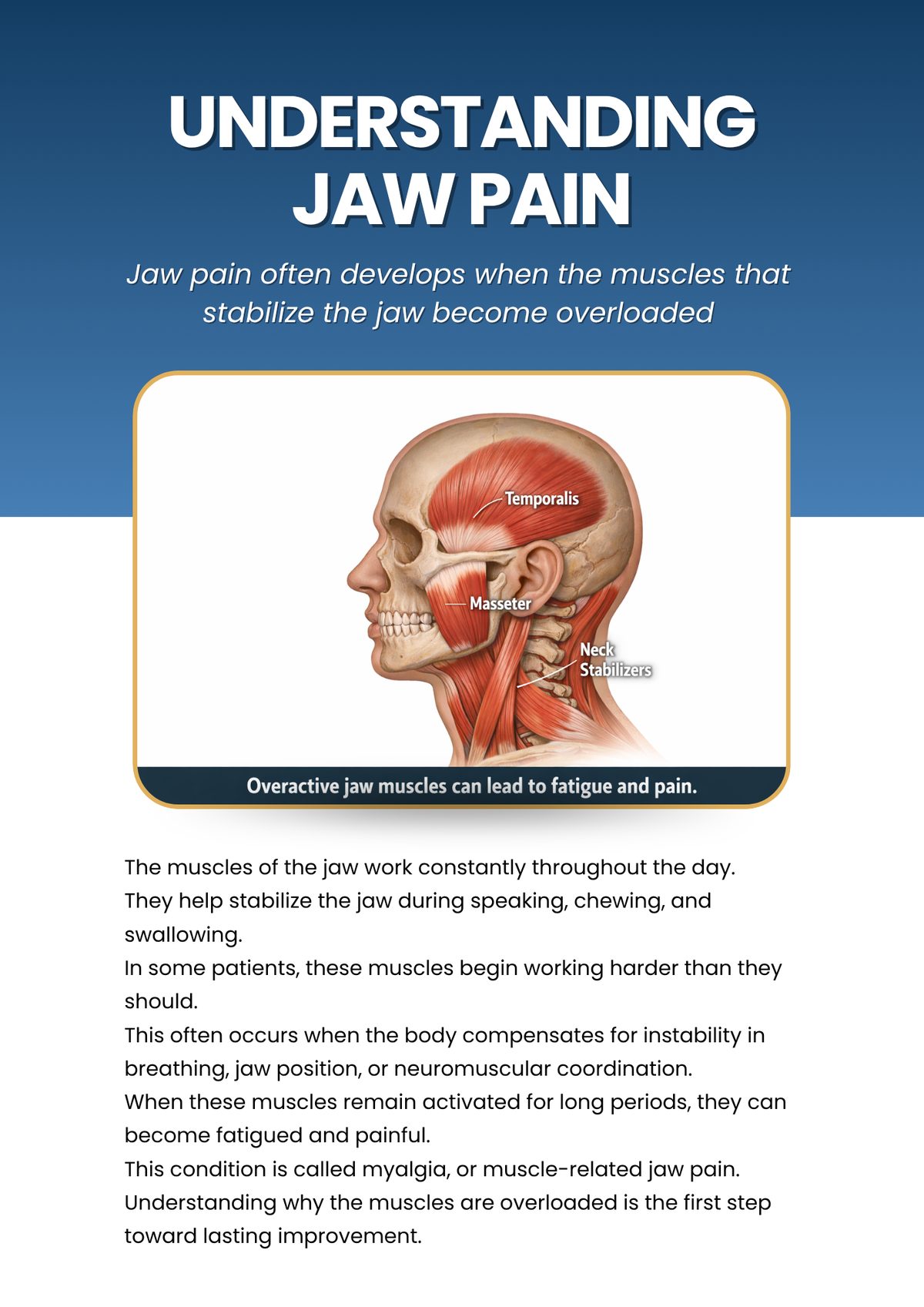
Jaw pain often develops when the muscles that stabilize the jaw become overloaded β compensating for instability in breathing, posture, or coordination long before you feel it.
If the underlying instability isn't addressed, these protective muscle patterns β clenching, grinding, headaches, facial fatigue β can become chronic. That's why fixing only the symptom often fails.
Jaw pain involves multiple systems, so we use a coordinated, conservative approach β combining muscle care, self-care and appliance therapy when indicated, and functional stabilization.
PBM (photobiomodulation) laser therapy is a research-supported adjunct for tension and pain in overworked jaw muscles; results vary.
Jaw exercises and self-care, plus a stabilization appliance when indicated, are part of conservative TMJ care.
CMDI stabilization retrains how the breathing, swallowing, and jaw muscles work together, to support jaw stability.
Dr. Shane Cope is a specialist in orofacial pain. Patients travel to Lafayette from across Indiana, Illinois, Ohio, Michigan, and Kentucky for a non-surgical evaluation and program.
About an hour from Indianapolis and a day trip from Chicago and Fort Wayne. We group sessions so out-of-town care takes fewer trips.
PBM laser therapy is a research-supported adjunct in the program, alongside conservative care; results vary.
A conservative, function-first program focused on jaw function and stability β not just masking the pain.
We evaluate both structure (joint, bite) and function (how the muscles coordinate) β then treat what's actually driving the pain.
PBM laser therapy and CMDI mapping are used together in the program.
For out-of-town patients we group sessions efficiently so treatment fits fewer trips.
Yes β the Jaw Pain Stabilization Program is entirely non-surgical. It combines PBM laser therapy (a research-supported adjunct; results vary) and CMDI neuromuscular stabilization to reduce muscle tension while improving the stability of the muscles that support the jaw. Most patients improve with conservative care; results vary.
The moment pain begins is rarely the true cause. The underlying problem usually develops slowly as muscles compensate for instability in breathing, posture, or jaw coordination. These patterns can exist for months or years before the muscles finally become overloaded β and then the pain appears suddenly.
The Jaw Pain Stabilization Program includes a comprehensive jaw and muscle evaluation, 8 PBM laser therapy sessions, and the CMDI stabilization program. A stabilization appliance, if needed, is discussed separately. You will receive a complete written estimate at your consultation, and monthly financing is available.
It can be. A night guard alone protects the teeth but may not address the muscle and coordination patterns underneath. Our program adds CMDI stabilization (guided muscle retraining) and PBM laser therapy aimed at those patterns. Most patients improve with conservative care; results vary.
Request a consultation. We'll evaluate what's driving your jaw pain and give you a clear, non-surgical plan.
Request a Consultation βAbout the doctor: Shane Cope, DDS, MSD β specialist in periodontics (Indiana University School of Dentistry) and in oral medicine and orofacial pain (University of Southern California).
Last reviewed October 2026
Highland Creek Family Dental's general dentists: Dr. Melinda Bodine, DDS (East Office) Β· Dr. Han Na Park (South Office).
Dr. Shane Cope, DDS, is a specialist in periodontics, oral medicine, and orofacial pain. Dental services on this site outside periodontics, oral medicine, and orofacial pain are provided by general dentists. Your right to a Good Faith Estimate.